
Yoga therapy for eating disorders patients in all levels of treatment
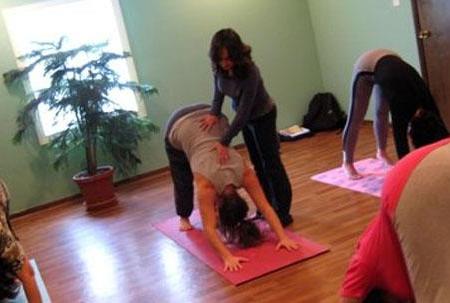
Yoga therapy can be a powerful healing tool for those who struggle with eating disorders. Throughout the continuum of care, yoga can be offered to patients. However, it is important for yoga practitioners to understand all facets of eating disorders before implementing yoga therapy with this population. This post will highlight how yoga therapists work in each level of care and discuss their experiences in integrating yoga therapy with patients.
Inpatient/Residential Levels of Care
Satya Larrea, C-IAYT and PRYT graduate, is the owner of Whole Yoga in Denver, Colorado who recently began working with patients at a national inpatient/residential eating disorders treatment center. At an inpatient level, patients are medically unstable as determined by abnormally low body weight, along with abnormal pulse, blood pressure, oxygen saturation levels and heart rhythm. They also may be suicidal and unable to contract for safety. At a residential level of care, patients are medically stable but have excessive eating disorders behaviors, ruminating thoughts and inability to interrupt the behaviors without intensive interventions.
Satya uses yoga therapy techniques for calming, centering and embodiment, including, mudras, breathing practices, postures, music, aromatherapy, and mindfulness. Her yoga therapy training in eating disorders, with me, taught her to make all postures optional. She learned what types of poses to teach patients in this level of care, which includes more gentle postures with options to sit, stand, lie down or simply sit on their mat, while breathing and observing.
Based on the high incidence of trauma in this population, Satya is aware that it is important to check in with patients about closing the door and acclimating them to the surroundings of the room while giving them the option to choose their space before beginning class. She engages with the patient when she notices them disassociating, drifting off, or staring out the window. She avoids certain words or naming body parts the same way she does when teaching a studio yoga class. “I don't use words like "body", "healthy", "stomach", "weight" etc. If a patient is pushing themselves too hard, I suggest that they check in with themselves and their level of effort. They're all there to recover and will back off intensity when redirected,” explains Satya.
Satya states, “It's challenging when patients want to go beyond their limits. I must guide them to not push themselves, so they don't injure themselves. I loved it when two of the patients told me that gentle yoga was the highlight of their week and that they had memorized the names of the movements, along with part of the sequence so that they could practice with each other during free time.”
She also adds, “My training in yoga therapy has given me the confidence to connect patients with eating disorders and meet them right where they are in their recovery process. The biggest reward is getting to know the patients over the weeks, seeing them connect to their bodies and feel less anxious about being in their bodies over time.”
Partial Hospitalization (PHP) and Intensive Outpatient (IOP) Levels of Care
Jackie Mucaria, C-IAYT and owner of Yoga for Positive Living, was an employee of mine at the Inner Door Center, where she trained in our program prior to her hire. Her role was in our PHP IOP programs. In a PHP, the patient is medically stable, but the eating disorder impairs functioning, though without immediate risk. They need daily assessment of physiologic and mental status. Although they are psychiatrically stable, they are unable to function in normal social, educational, or vocational situations. They engage in daily binge eating, purging, fasting or very limited food intake, along with other pathogenic weight control techniques.
In an IOP, the patient is medically stable and no longer needs daily medical monitoring. The patient is psychiatrically stable and has symptoms under sufficient control to be able to function in normal social, educational, or vocational situations and continue to make progress in recovery.
As a yoga therapist, Jackie guided patients through yoga practices with a strong focus on internal self-awareness. The purpose of yoga therapy at the Inner Door Center was for patients to use yoga postures, breathwork, and meditation as a form of self-study. “Since the way we show up on our yoga mat tends to mirror the way we show up in life, yoga therapy acts as a lab where one can become aware of their internal landscape, and practice developing new tools such as non-reactivity, patience, self-compassion, trust, breathing through challenging moments, and changing one's internal dialogue,” explains Jackie. She continues to convey, “For those with eating disorders, this is especially important, as every disordered behavior can be traced back to the internal experience, usually thoughts or beliefs. I encouraged clients to lean into the experience, especially the uncomfortable parts, to learn more about themselves and apply this self-awareness to their recovery. For example, how does it feel when I'm outside of my comfort zone? What is my go-to reaction? How is my relationship to my body? What does this experience tell me about my eating disorder? How can I offer myself compassion today?”
In our PHP/IOP, all therapeutic groups, including psychotherapy and nutrition, had a different overall focus based on the chakra system, which acted as a map for exploring patient’s entire self: physically, mentally, emotionally, and spiritually. Group yoga therapy was followed by journaling and a group discussion to help better understand the experience. Individual yoga therapy was very similar, however there was an opportunity to dive deeper into a patient’s specific recovery. Working one on one allowed the patient to develop specific goals and break down the experience more thoroughly.
Jackie conveyed that one of her most rewarding experiences was working with a patient who was a 13-year-old girl who was worried, uptight, fearful, and introverted. Kara (not her real name) didn’t know her own voice, only the voice of the good girl she longed to be. She became overly critical of herself and took on unnecessary blame, even for things that had nothing to do with her including her parent’s violent arguments. When Kara got her first period, she noticed her body beginning to take on a different shape. With new curves forming and new hair growing, she faced increasingly high anxiety and worry that she would stand out to others. She began eating smaller, portioned amounts at meals, paced up and down her living room stairs, and stayed up at night devising plans to fix the turmoil she was facing in her body and in her home. Her anxiety started to replace meals, and hunger was no longer a signal she was aware of in her body.”
Based on the method I created using the chakra system in eating disorders treatment, Jackie identified Kara’s issues as a fifth chakra imbalance, which can show up in many ways for those struggling with eating disorders and disordered eating. Many times, this person loses their own voice to the demands of their eating disordered voice or can no longer differentiate the two. By exploring her preferences, thoughts and opinions through yoga therapy, Kara began to deal with her anxiety and express herself in a healthy and confident way. Jackie recalls, “Observing Kara’s body language on her yoga mat revealed an internal resistance. By focusing on postures that opened her throat, accompanying my dialogue, Kara began to come out of her shell, began to form her own opinions and express herself – first in an unhealthy way by screaming and yelling at me – then by cultivating balance in speech, tone of voice and integration with other peers in the milieu. In addition, breathing through an uncomfortable yoga pose helped Kara breathe through an uncomfortable lunch. By offering her body compassion on her yoga mat helped her offer herself compassion through the toughest moments of recovery.”
According to Jackie, “Working with the Inner Door Center team was the most cohesive and supportive experience I've ever had in a work setting. Everyone was so committed to supporting the patients and supporting one another as a team. The treatment team recognized the value of yoga in the patient’s treatment plan and supported me as a coworker. I really enjoyed being a part of the professional development workshops and trainings as I was able to weave this knowledge into yoga therapy and mealtime support. I also documented my sessions in each patient’s medical record and was included in bi-weekly patient case consultations.”
Outpatient Level of Care (OP)
Mimi Rose, C-IAYT and PRYT graduate, is the owner of Diamond Health in Charleston, South Carolina. She is a therapeutic yoga practitioner who works with individuals who struggle with eating disorders and disordered eating. Like an IOP, in an OP level the individual is medically and psychiatrically stable, with symptoms under sufficient control for day-to-day functioning.
With the combination of therapeutic yoga, along with the skills honed our yoga and eating disorders training program, she was provided a concrete platform from which to facilitate the recovery of individuals who are interested in exploring a relationship with their body while understanding their relationship with food. She works with individual clients and small groups. “Through the creation of safe space, confidentiality and an awareness of my personal scope of practice, my work as a therapeutic yoga practitioner with an emphasis on disordered eating has become known among my clients, and the clients who have been referred to me as a refuge where honesty, vulnerability and trust become experiential, “explains Mimi.
What Mimi has found to be most rewarding is working in service to facilitate relational opportunities with the body – the feeling body - and being an observer of the body and the mind when they work together and when they are in conflict. In addition, she can witness when an individual sees and feels this for themselves.
“What I have found to be most challenging,” states Mimi, “is when a situation becomes beyond my scope of practice and referrals that I make to my clients – for their health and safety – are disregarded. It’s a genuine sense of loss that I feel in my own body. There are few places where I live that offer resources that serve this population. From my training in eating disorders, I have realized the tremendous value of working with a treatment team as a way of supporting clients in the many and varied facets of this disorder. It is essential.”
A particular recovery success story Mimi shares is, “One of my clients came to me when she was quite young. Early twenties. She was in the middle of an episode that was alarming. She was working with a psychotherapist at the time as well. Several sessions in – she had an important realization – through the felt sense of her body, that this disorder was multi-generational and that she did not want her future children to suffer in the same way that she had in her own life. She doubled down and devoted herself to the work and overcame her disorder over the three years of working her therapist and myself. She is now pregnant and expecting her first child. I am grateful for the trainings that I have received and for being able to offer the work that I do.”
Physiological and Psychological Benefits of Yoga Therapy in Eating Disorders Treatment
The benefits of yoga on eating disorder treatment are numerous. From a physiological standpoint, yoga intertwines with the Polyvagal Theory, coined by Stephen Porges. The vagus nerve, the largest nerve in the body, has various branches innervating responses. These include detection safety (engagement and connection with others), danger (fight/flight) and life threat (complete shutdown and immobilization). Yoga targets all sections of the vagus nerve by promoting safety and putting the brakes on the fight/fight and shut down modes.
Yoga decreases cortisol levels in the body resulting in increased bone formation and calcium absorption. This is important especially for the individual struggling with AN as bone mass is compromised due to malnutrition.
By its direction to the parasympathetic nervous system, yoga promotes homeostasis of digestive tract as individuals who struggle with eating disorders suffer from gastrointestinal disturbances from a physiological and emotional standpoint.
Yoga can increase the levels of gamma amino butyric acid (GABA) in the brain by more than 20 percent resulting in a reduction in anxiety. Mindful Yoga and meditation can affect the cerebral cortex, improving focus and awareness, while decreasing impulsivity, irrational thoughts, and behaviors.
Learning to stay with postures that are difficult and awkward can help individuals learn to observe vs. react to discomfort in their lives by breathing and listening carefully to the mind when faced with challenging situations.
Individuals begin to enjoy their body for the first time, leading to improved body image. They start to define their body in terms of “what it can do” versus “what it is” as they learn that they are not mere extensions of their body but possess beautiful internal qualities.
Yoga can help individuals tune in to the body's signals of hunger and satiety as they become aware of physical sensations. In this way, they can trust their body messages vs chronic dieting.
Yoga also emphasizes mindfulness teaching the individual to experience the taste, texture, and other sensual qualities of food, while making thoughtful vs impulsive choices related to eating behaviors, substance use and daily life decisions.
Most importantly, individuals learn how to take yoga off their mat to help them stay present, in all situations that they are faced with, by drawing attention back to the breath. Although many poses are uncomfortable, others are also meant to be enjoyable, helping the individual engage into life by “letting go” of whatever they are holding on to that is hindering them from untangling the hold of their addiction. By experiencing their physical edge, they begin to peel away layers and tap into emotional and spiritual edge.